
My primary research focuses on improving coral bleaching prediction by understanding how environmental conditions and thermal history influence coral sensitivity to heat stress. I have also co-authored research focusing on sea cucumbers and whale sharks, in which I assisted in data collection in the field and subsequent data analysis.
Below is a selection of my peer-reviewed publications:

1. Assessing chlorophyll a as a proxy for coral bleaching factors across inshore and offshore reef environments
Authors: Valerie J Cornet, Scott F Heron, Karen E Joyce
Date Published: 2026/7/30
Journal: Environmental Modelling and Assessment
Read Abstract:
Coral bleaching is primarily driven by heat stress, yet additional environmental factors, such as nutrient availability and light attenuation, can affect bleaching severity. In this study, we assessed the interactive effects of chlorophyll a concentrations with heat stress (Degree Heating Weeks, DHW) on bleaching severity across inshore and offshore reefs of the Great Barrier Reef (n=1397). Using Generalised Additive Models, we tested multiple chlorophyll a metrics (mean, maximum, minimum, and cumulative sum) across different time frames (3–12 weeks) to determine their predictive value. Results revealed that the relationship between chlorophyll a and bleaching severity varied by reef location. At inshore reefs, where chlorophyll a served as a proxy for nutrient enrichment, exposure to elevated concentrations lowered bleaching thresholds, increasing bleaching sensitivity. In contrast, at offshore reefs, where oligotrophic conditions dominate, chlorophyll a fluctuations likely reflected upwelling-induced cooling and moderate nutrient enrichment, initially buffering corals from bleaching but increasing severity when excessive accumulation occurred. Long-term chlorophyll a metrics (9–12-week mean and cumulative sum) improved predicted bleaching (adj. R2=0.55–0.57) compared to heat stress alone (adj. R2=0.49), lowering DHW thresholds inshore but raising them offshore. These findings suggest the value of integrating chlorophyll a with DHW in forecasting frameworks to improve coral bleaching risk assessments, supporting policies focused on nutrient mitigation at inshore sites and monitoring of upwelling-modulated dynamics offshore. As global warming intensifies, increasing DHW and shifting nutrient dynamics will likely alter these relationships, necessitating further refinement of bleaching prediction to support conservation strategies.
2. Using biotelemetry to assess drone effects on whale sharks
Authors: Samantha D Reynolds, James Redcliffe, Valerie J Cornet, Vincent Raoult, Mark Holton, Rory P Wilson, Bradley M Norman
Date Published: 2026/4/1
Journal: Ecosphere

Read Abstract:
The use of unoccupied aerial vehicles or drones for wildlife research has proliferated in recent years and they have proven to be a valuable tool for collecting data for population surveys, morphometric and body condition measurements, and for observing behavior. The need to assess the impacts of drones themselves on wildlife is increasingly being recognized, not only for ethical considerations but also before attempting to record “natural behavior.” While effects of drones have been seen in some marine species, such as whales, dolphins, and seabirds, these are highly variable across and within taxa and are typically assessed through observations of behavior. Effects on water-breathing animals are understudied. Drones have already been used in studies of the world’s largest fish, the whale shark (Rhincodon typus), but their effects on the species are yet to be quantified. This study is the first to use biotelemetric data to assess the effects of drones on the natural behavior of a water-breathing marine species. Rather than relying on observations of behavior that can be impacted by observer bias, we employed behavioral data-logging tags, incorporating tri-axial accelerometers and magnetometers, to record fine-scale whale shark activity and diving behavior in the presence and absence of a drone. Activity was measured by the vector sum of the dynamic body acceleration (VeDBA), calculated as the vector sum of the dynamic components of tri-axial acceleration, and tail beat frequency (TBF) as an indicator of swimming effort. Generalized linear mixed modeling found no evidence that drone presence (10–60 m altitude) or its vertical movement (ascent/descent) increased whale sharks’ diving or activity compared to when the drone was absent. Our study provides confidence to researchers and managers that drones are a minimally invasive research tool for whale sharks, although we advocate a precautionary approach to their use and consideration of their potential effects on non-target species. Furthermore, our method of objectively assessing the effects of drones using biotelemetry could be effectively applied to a wide range of species inhabiting the aquatic, terrestrial, and aerial environments, facilitating comparisons within and among species, and allowing multispecies or ecosystem assessments.
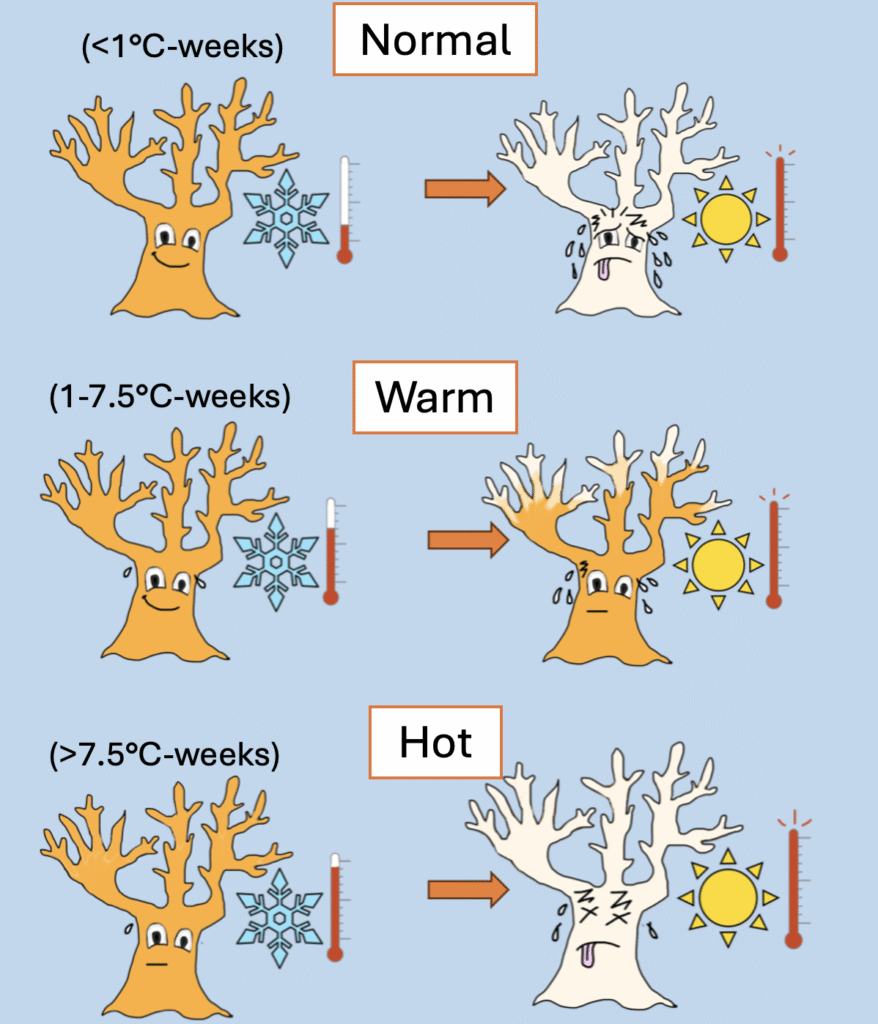
3. Do pre-summer temperatures influence coral bleaching prevalence and severity?
Authors: Valerie J Cornet, Neal E Cantin, Karen E Joyce, Scott F Heron
Date Published: 2026/1/3
Journal: Coral Reefs
Read Abstract:
Predicting coral bleaching events has been key to reef conservation management efforts. Current satellite-based bleaching prediction tools offer effective regional-scale alerts of bleaching risk, but lack reliability at the reef-scale. Bleaching models focus on predicted heat exposure during summer, omitting critical factors that influence heat stress responses and the subsequent coral reef community bleaching severity. The IPCC framework however assesses the susceptibility of a system to be harmed by climate change based on exposure, sensitivity, and adaptive capacity. In this perspective, we propose integrating the IPCC vulnerability framework to develop a holistic coral bleaching prediction model that accounts for reef-scale exposure to heat stress, species-specific sensitivity, and adaptive capacity. We specifically recommend: 1) incorporating historical temperature metrics to account for acclimatisation responses, 2) including community composition metrics to better reflect variations in sensitivity at the reef scale, and 3) addressing environmental conditions to identify potential refugia and refine predictions. We discuss these factors and the feasibility to inform metrics for use in prediction tools. Historical temperature is identified as a primary target, with community composition and environmental drivers recommended for further exploration as data availability improves. Future assessments of these sensitivity metrics should be integrated into an experimental framework to further refine and improve prediction tools. This perspective underscores the urgency of refining coral bleaching prediction models and directly supports reef conservation efforts in the face of climate change.
4. Modernising sea cucumber surveys using remotely operated vehicles and aerial drones
Authors: Jane E Williamson, Karen E Joyce, Stephanie Duce, Matthew Koopman, Joan YQ Li, Troy F Gaston, Ian Knuckey, Kristen L McSpadden, Natasha Garner, Valerie J Cornet, Patrick J Burke, Adrian Flynn, Vincent Raoult
Publication Date: 2025/12
Journal: Coral Reefs

Read Abstract:
There is an urgent need for improved monitoring approaches to rapidly and accurately assess sea cucumber populations at ecologically relevant scales. Timely surveys are critical for informing effective fisheries management and decision-making. Traditional surveys, undertaken via snorkelling, manta tows, or SCUBA, are limited to shallow and accessible areas; however, sea cucumbers inhabit a broad range of depths, including areas beyond safe diving limits and exposed shallow waters inaccessible by boat. To overcome these limitations and increase the rapidity of field collection, we propose the use of remote sensing technologies to survey sea cucumber populations across a range of depths. Here, we evaluated the effectiveness of aerial drones and in-water remote operated vehicles (ROVs) for assessing sea cucumber species and abundances across various depth ranges (< 50 m) on the Great Barrier Reef, Australia. Aerial drone orthomosaics and ROV video footage were compared to more traditional snorkel and SCUBA-based assessments conducted at similar depths. The vast majority of pairwise comparisons between in-water ROV video counts and snorkel or SCUBA assessments found no significant differences in sea cucumber assemblages. Counts from aerial drone-derived orthomosaics, however, were significantly lower, counting approximately half as many sea cucumbers as snorkel counts. This was largely attributed to poor weather during the drone surveys. Remote methods were significantly faster in the field for surveying a given area than traditional methods. Given that towed ROVs can efficiently cover a broader depth range and aerial drones are effective for survey shallow areas under suitable weather conditions, we recommend using a combination of aerial drones and towed ROVs to survey sea cucumbers, with tool selection guided by prevailing weather conditions. This approach offers the advantages of collecting multiple types of data from a single data source, vastly increasing survey efficiency, and providing a historical record for future assessments. The methods have the potential to be used to survey other benthic–associated species.
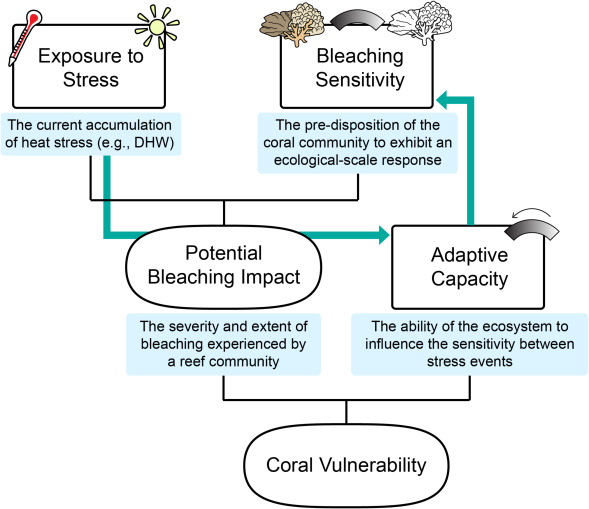
5. Enhancing coral bleaching predictive tools through integrating sensitivity to heat exposure
Authors: Valerie J Cornet, Neal E Cantin, Karen E Joyce, William Leggat, Tracy D Ainsworth, Scott F Heron
Publication Date: 2025/2/1
Journal: Biological Conservation
Read Abstract:
Predicting coral bleaching events has been key to reef conservation management efforts. Current satellite-based bleaching prediction tools offer effective regional-scale alerts of bleaching risk, but lack reliability at the reef-scale. Bleaching models focus on predicted heat exposure during summer, omitting critical factors that influence heat stress responses and the subsequent coral reef community bleaching severity. The IPCC framework however assesses the susceptibility of a system to be harmed by climate change based on exposure, sensitivity, and adaptive capacity. In this perspective, we propose integrating the IPCC vulnerability framework to develop a holistic coral bleaching prediction model that accounts for reef-scale exposure to heat stress, species-specific sensitivity, and adaptive capacity. We specifically recommend: 1) incorporating historical temperature metrics to account for acclimatisation responses, 2) including community composition metrics to better reflect variations in sensitivity at the reef scale, and 3) addressing environmental conditions to identify potential refugia and refine predictions. We discuss these factors and the feasibility to inform metrics for use in prediction tools. Historical temperature is identified as a primary target, with community composition and environmental drivers recommended for further exploration as data availability improves. Future assessments of these sensitivity metrics should be integrated into an experimental framewor to further refine and improve prediction tools. This perspective underscores the urgency of refining coral bleaching prediction models and directly supports reef conservation efforts in the face of climate change.
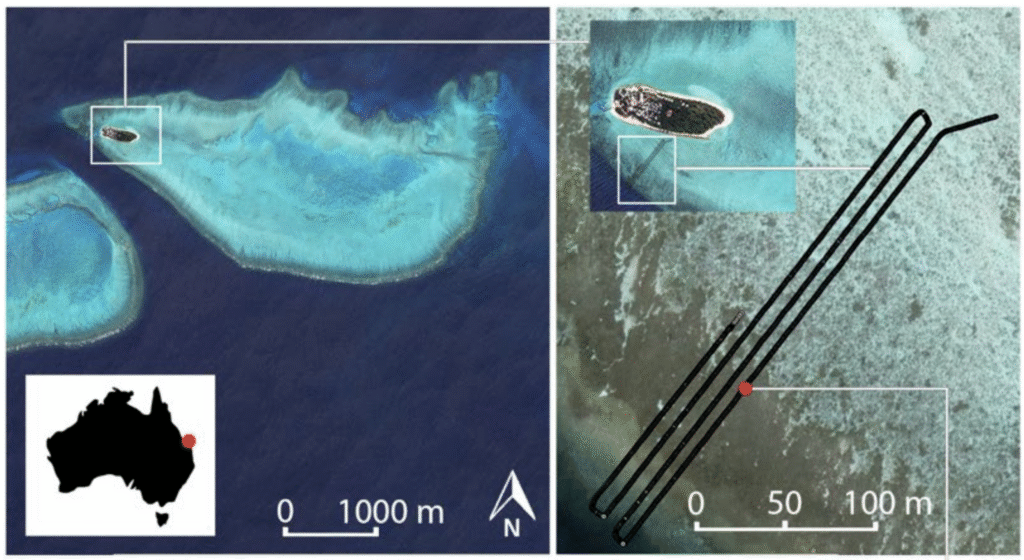
6. Assessing the potential of remotely-sensed drone spectroscopy to determine live coral cover on Heron Reef
Authors: Valerie J Cornet, Karen E Joyce
Publication date: 2021/4/17
Journal: Drones
Read Abstract:
Abstract:
Coral reefs, as biologically diverse ecosystems, hold significant ecological and economic value. With increased threats imposed on them, it is increasingly important to monitor reef health by developing accessible methods to quantify coral cover. Discriminating between substrate types has previously been achieved with in situ spectroscopy but has not been tested using drones. In this study, we test the ability of using point-based drone spectroscopy to determine substrate cover through spectral unmixing on a portion of Heron Reef, Australia. A spectral mixture analysis was conducted to separate the components contributing to spectral signatures obtained across the reef. The pure spectra used to unmix measured data include live coral, algae, sand, and rock, obtained from a public spectral library. These were able to account for over 82% of the spectral mixing captured in each spectroscopy measurement, highlighting the benefits of using a public database. The unmixing results were then compared to a categorical classification on an overlapping mosaicked drone image but yielded inconclusive results due to challenges in co-registration. This study uniquely showcases the potential of using commercial-grade drones and point spectroscopy in mapping complex environments. This can pave the way for future research, by increasing access to repeatable, effective, and affordable technology.